
Leased and rented out: how to see what each vehicle actually makes
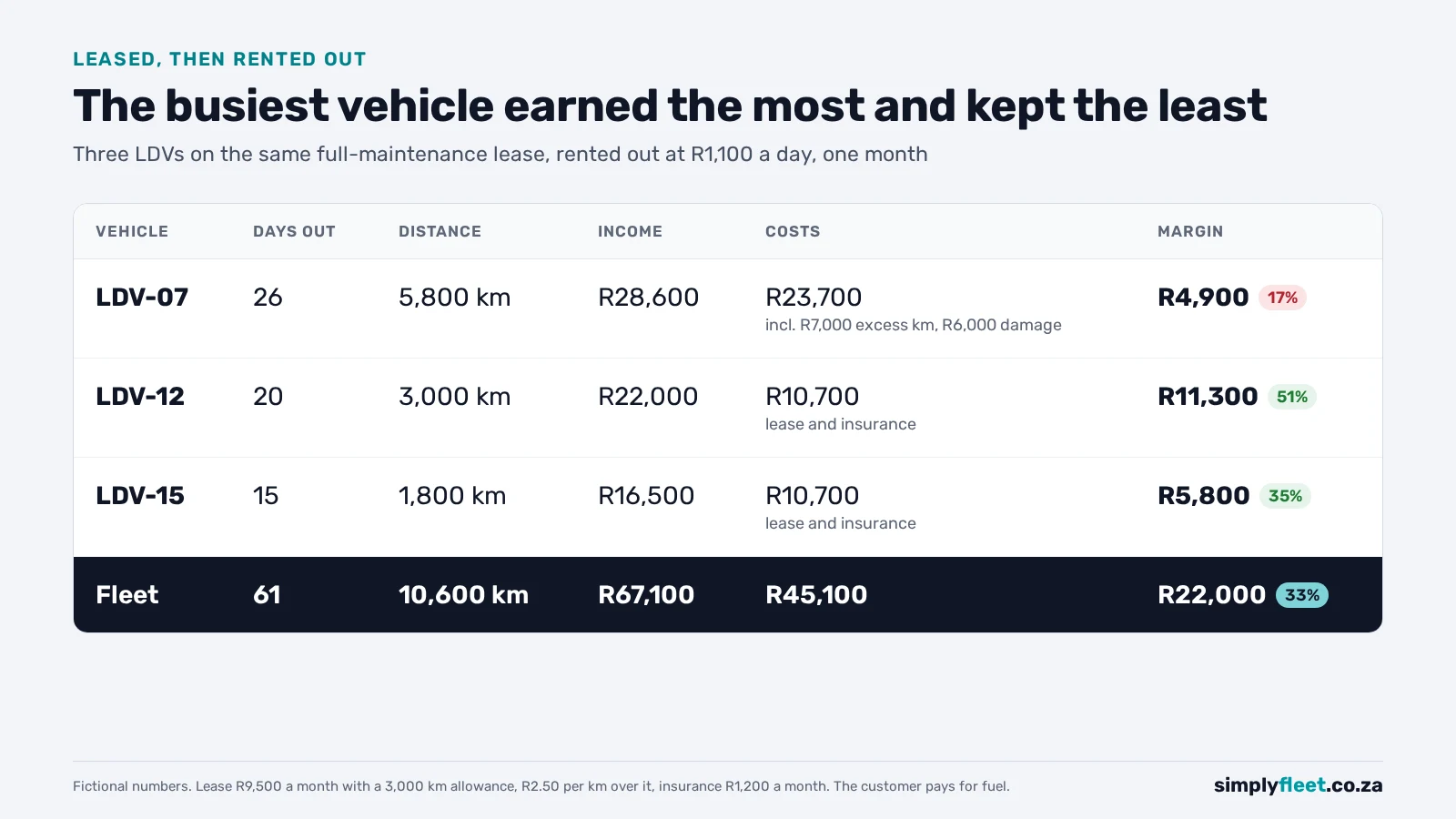
In short: if you lease vehicles on a full-maintenance lease and rent them out, fleet profitability per vehicle is what counts, not the monthly total. The lease looks like a fixed cost, but excess kilometres and the costs the lease doesn’t cover land hardest on the vehicles you rent out most. In the example at the top of this post, the busiest LDV brings in the most income and keeps the least. You only see that if every cost and every rand of charge-out income sits against the vehicle it belongs to.
What a full-maintenance lease leaves out
A full-maintenance lease covers the vehicle, its services, maintenance and usually tyres for one monthly amount. Lessors sell it on budget certainty, and on paper that’s true. Three things still sit outside it:
- Fuel and insurance. They aren’t part of the monthly rental.
- Damage beyond fair wear and tear. It’s charged on top, and the vehicle has to go back in fair condition.
- Excess kilometres. Go over the contract’s allowance and you pay a rate for every extra kilometre. Run under it and there’s usually no credit.
All three grow with use. A vehicle that’s out on hire every day runs up kilometres, picks up dents and gets driven by more people.
A worked example
Take three LDVs on the same lease: R9,500 a month, a 3,000 km monthly allowance, R2.50 for every kilometre over it, and R1,200 a month for insurance. You rent them out at R1,100 a day and the customer pays for fuel. The numbers are made up, and the table at the top shows the month.
LDV-07 was out 26 days and earned R28,600, the most of the three. It also ran 2,800 km over its allowance (R7,000) and came back with a damaged bumper (R6,000), so it kept R4,900. LDV-12 earned less and kept more than twice as much. The fleet as a whole made a 33% margin, which looks fine and tells you nothing about LDV-07.
That changes decisions. Maybe LDV-07’s customer needs a higher daily rate or a kilometre cap. Maybe that work belongs on a vehicle with a bigger allowance, or the lease needs restructuring before the contract ends. You can only ask those questions once you see the vehicle’s own figures.
Why it’s hard to see in a spreadsheet
The numbers for one vehicle come from four places: the lessor’s statement, the damage and excess-kilometre invoices, the insurance schedule, and your own charge-out invoices in the accounting system. Each arrives on its own date, in its own format, often with the registration written differently. Someone has to match them by hand every month, and the excess-kilometre bill often only arrives at the end of the contract, long after the work that caused it.
So most businesses look at the total. Income less lease costs is positive, and the month is called good.
How it works in a system
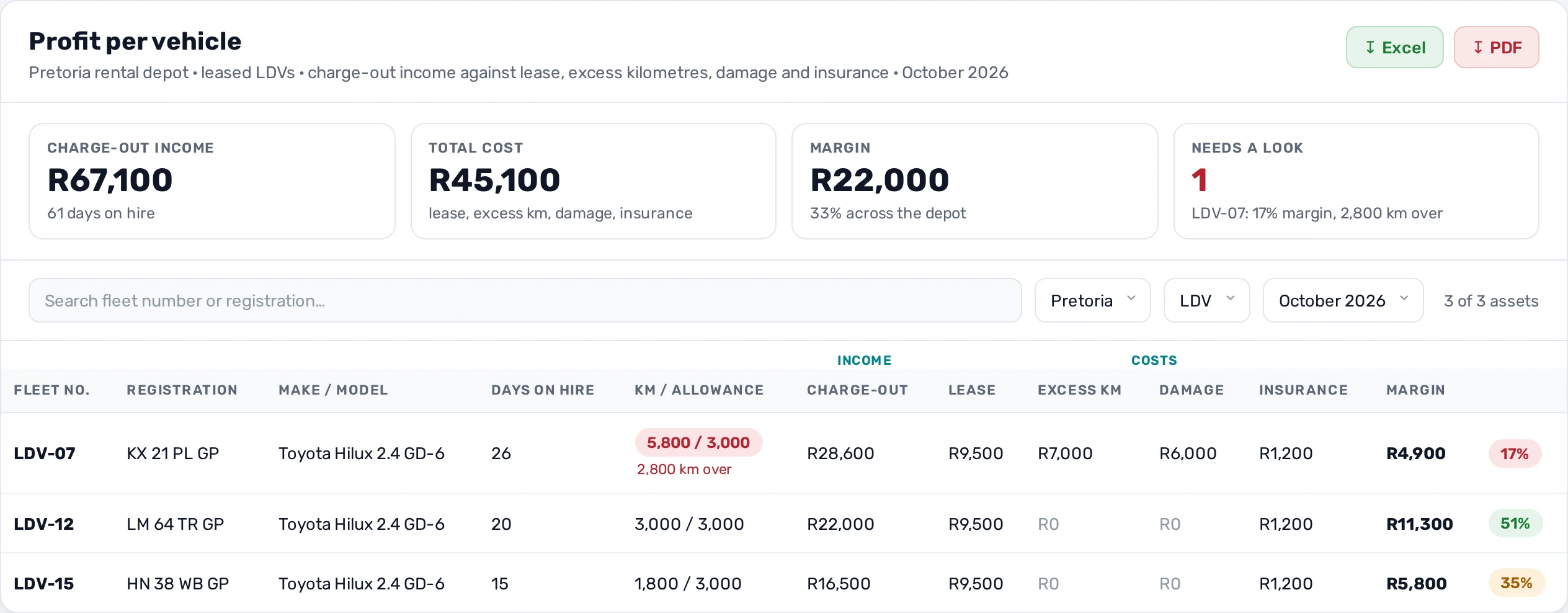
In Simply Fleet, every cost lands on the vehicle that caused it. Fuel, tolls, repairs and running costs come together on one record, in the expense categories your finance team uses, and cost per kilometre is worked out from there. Each vehicle’s kilometres are measured against its lease allowance, so you see which units are over-running while there’s still time to act, not when the lessor’s bill arrives.
Simply Fleet connects to the systems you already use, including finance and leasing companies, so costs and charge-out income can come in without retyping. Put them together and you get a screen like the one above: what each vehicle earned, what it cost, and which one to look at first. One of our clients leases its fleet and rents it out, and this per-vehicle view is what it needed.
If you’d like to see it with your own fleet’s numbers, book a demo.
Sources
- VWFS Fleet Mobility Solutions, Fleet frequently asked questions: fuel and insurance not in the FML rental; extra charges for excessive usage and damage outside fair wear and tear
- Eqstra, Does it make sense to lease?: excess-kilometre penalty, no credit for unused kilometres, vehicles returned in fair condition
- g-FleeT Management, Full maintenance lease: penalties for excess kilometres
More from On the Move: How to cut fleet costs without compromising efficiency · The importance of data-driven decisions in fleet management