How to choose fleet management software in South Africa
A buyer’s guide for fleet managers who already know where their vehicles are, and need a fleet management system for everything else.

In short
Most fleets in South Africa already know where their vehicles are. What they don’t know is what’s wrong with each one, when it’s due for a service, and why it costs what it does. Choose fleet management software by listing every problem your fleet has, then testing each supplier on those problems with your own vehicles and your own people. A system that only solves the location problem has solved one of your ten.
A tracker tells you where. You need to know what’s wrong with it.
Ask a fleet manager where vehicle 14 is right now and they can usually tell you in seconds. Ask them when it’s due for a service, whether the driver reported a defect this morning, or why it’s on its third set of tyres this year, and the answer is usually a spreadsheet or a phone call.
That gap is why buying fleet software goes wrong so often. In South Africa, "fleet management" mostly means tracking. At the end of 2023, five tracking companies held about 70% of the country’s fleet management units, and the analysts who count them note that "a notable share" of those units are low-end tracking systems with a few fleet features added [S1]. So when a business decides it needs a fleet management system, it usually phones a tracking company, and a year later it can see every vehicle on a map and still can’t answer the questions that cost it money.
| The question | A tracker answers it | Fleet management software answers it |
|---|---|---|
| Where is the vehicle, and where has it been? | Yes | Uses the tracker’s data |
| How far has it driven? | Yes | Uses it to schedule services and work out cost per km |
| When is its next service due? | Some can, by kilometres only | Yes, by kilometres, time or both, with the history behind it |
| What did the driver find on this morning’s inspection? | No | Yes |
| Why is this vehicle costing more than the others? | No | Yes |
| Is the driver’s licence or PrDP about to lapse? | No | Yes |
| Who had the vehicle when the fine was issued? | Partly | Yes |
A tracker is a good source of information, and good fleet software uses it. The questions in the right-hand column still need a system of their own.
Write down your ten problems before you see a single demo
Before you speak to any supplier, sit down with whoever runs the fleet day to day and list what actually goes wrong. Most lists look something like this:
- Services are missed or done late, and nobody knows until something breaks.
- Some vehicles cost far more to run than others, and nobody can say why.
- Tyres, batteries or repairs keep coming back on the same vehicles.
- Drivers report defects on paper or WhatsApp, and they get lost.
- Fines arrive and nobody can match them to the driver.
- Licence discs, driver’s licences and PrDPs lapse.
- Fuel spend doesn’t line up with the kilometres driven.
- Some vehicles sit parked while other branches are short.
- Repair quotes get approved over the phone with no record.
- Month-end reporting takes days of copying numbers between systems.
Rank them by what they cost you, then judge every supplier on how many of them they solve, for everyone who touches the fleet: the driver doing the inspection, the branch manager approving the repair, the workshop doing the job card, finance paying the bill.
Find out where the money goes
A large fleet is expensive to run when you can’t see where the costs go. To get a sense of scale, SARS’s own cost scale for the 2026 tax year allows 47.4c to 122.5c per kilometre for maintenance, repairs and tyres alone, depending on the vehicle’s value, before fuel and before the fixed cost of owning it [S2]. Those are tax figures, not a benchmark for your fleet, but they show how quickly a few rand per kilometre adds up across a few hundred vehicles.
The question for any supplier is whether the system can show you cost per kilometre for each vehicle, split into fuel, maintenance, tyres and repairs, and point you at the vehicles that are out of line. That depends on two things: an odometer reading you can trust, and every cost landing on the right vehicle.
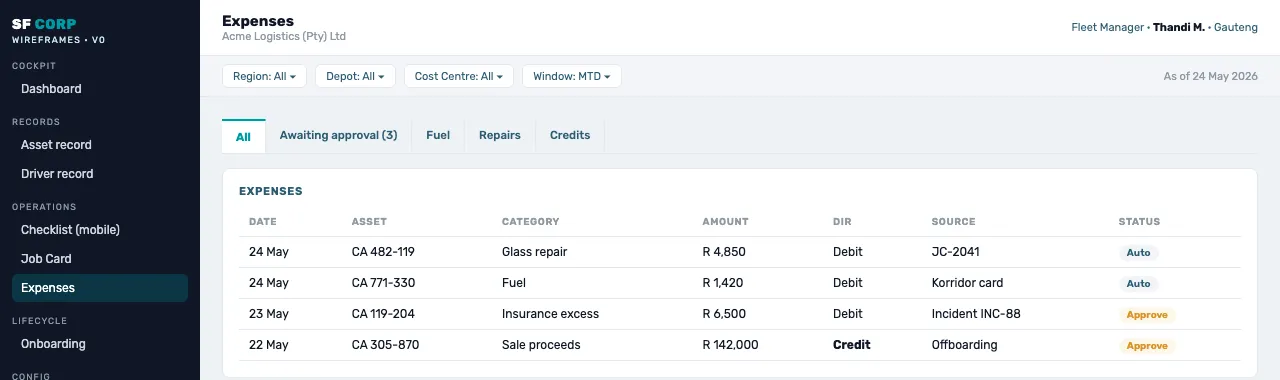
One of our clients put it this way: "we have in most cases the actual vehicle kilometers captured twice a day meaning we could make away with the Excel spreadsheet" (Adri Botha, 24/7 Security Services).
Are you running too many vehicles, or too few?

Utilisation is the problem nobody puts on the feature list. A vehicle that’s parked most of the month still costs its full insurance, licence, finance and depreciation. A vehicle that’s overworked wears out early and takes its maintenance costs with it.
The cause is usually not knowing rather than not tracking. When the US Government Accountability Office reviewed 2,300 vehicles at one federal agency, the agency hadn’t worked out how much 81% of them were being used, partly because the data was hard to collect by hand. Two agencies together spent about $13.5 million in a year maintaining and depreciating vehicles whose use was unknown [S3]. That’s a 2017 US example, but the pattern is familiar to any large fleet.
Ask each supplier to show you which of your vehicles are under-used and which are over-used, by branch, and what the system does with that information.
Start with what you already pay for
Most South African fleets already have a tracker, fuel cards, and often a lease or maintenance plan, plus a finance or HR system. Each one holds a slice of the picture. A new system that ignores them means someone retypes numbers every month, and one that insists on replacing them adds cost you may not need.
So before features, ask about connections. For each system you already use: does the supplier connect to it already, who builds the connection if not, and who fixes it when the other system changes?
Simply Fleet connects to systems that allow a connection, including trackers, fuel cards, leasing companies, fines providers, ERP and finance, and HR and payroll, and it can pass information between two of them.
One of our clients shows why this matters. It has its assets on full maintenance leases and rents those same assets out to its own customers. The lease costs, the running costs and the rental income each sat somewhere different, so nobody could say which vehicles, or which types of asset, were actually making money. We set up one platform where each asset’s costs sit next to what it is charged out at, so profitability can be compared vehicle by vehicle and across asset types. Bringing those pieces together is what fleet management software is for.
Check it handles South African paperwork
Foreign buyer’s guides can’t help you here. Any system you choose for a South African fleet should handle these:
- AARTO. The second phase went live on 1 July 2026 in 62 municipalities, including the major metros outside the Western Cape, and government is aiming for national coverage by January 2027. Demerit points may follow later [S4]. Every infringement needs to be matched to the driver who had the vehicle that day.
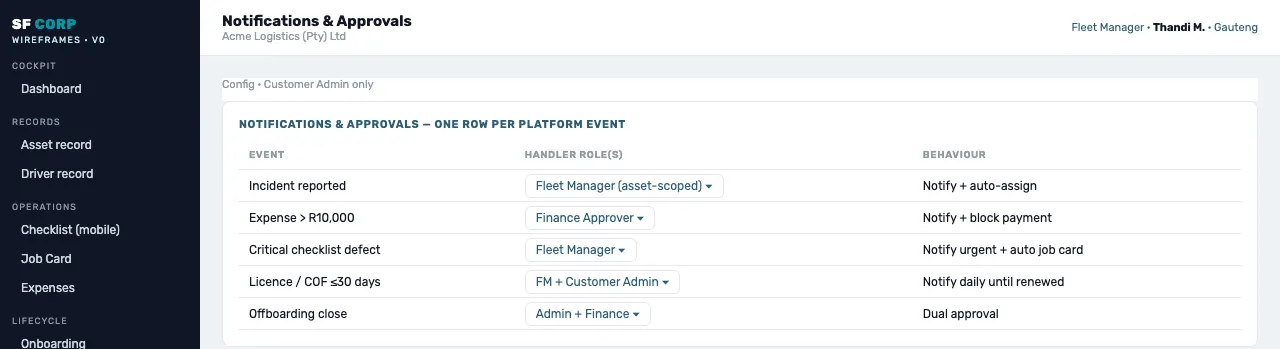
- PrDPs. An owner may not let someone drive a vehicle that needs a professional driving permit unless that person holds the right category [S5]. The system should know which vehicles need one and chase each permit before it expires.
- Licence discs. The RTMC reported over a million discs expiring each month in late 2025 [S6]. A fleet needs every renewal date in one place, well before the disc lapses.
- POPIA. Driver data such as licences, fines and inspection photos is personal information. Ask the supplier what lawful basis its clients use for driver data. Consent is often the wrong one for employees [S7].
Ask what happens where there’s no signal
On paper, South Africa looks well covered: ICASA reports 4G reaching 99.5% of the population. But broadband reaches only about 82% of the country’s land area [S8], and the other 18% is where mines, farms, plantations and long-haul routes are.
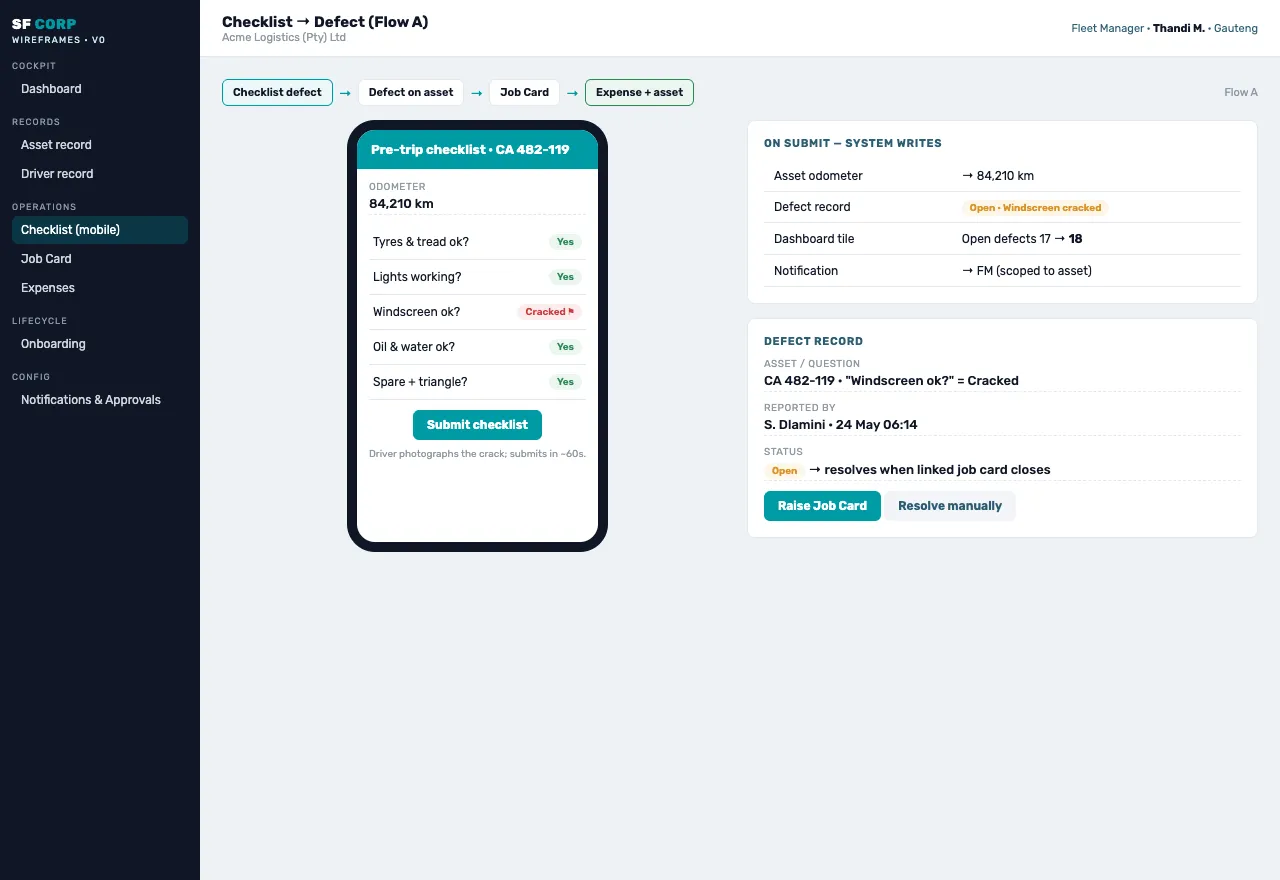
If your vehicles work far from town, ask every supplier whether a driver can complete an inspection, or a mechanic a job card, with no signal, and have it send once they’re back in range. Then test it in the trial with the phone in flight mode.
Simply Fleet’s driver checklists can be completed and submitted without a signal.
Make sure it fits how you work, and test it with your people
Off-the-shelf systems come with the supplier’s checklists, approval flow and reports, and your team works around them. That’s fine for a simple fleet. It gets hard when you have several branches, more than one approver for a repair, vehicles shared across shifts, lease kilometre limits, or a finance team that reports by its own cost centres.
The best test is the same for every supplier. Pick three real tasks from your problem list, such as a driver’s morning inspection, a repair quote that needs two approvals, and your month-end cost report. Ask each supplier to show you those three, set up for your fleet, not their standard demo. Then hand a phone to one of your drivers and watch them use it.
After go-live, ask how long a small change takes. With Simply Fleet, small changes such as a new report layout or a new field on a record are usually done the same day.
Work out the real cost over three years
Compare what you’ll pay over three years, not the monthly rate on the first quote. Ask about the once-off setup fee and what it covers, whether you pay per vehicle, per user or both, whether connections to your other systems are included or quoted later, what a change costs after go-live, and what happens to the rate as the fleet grows.
Simply Fleet charges a once-off setup fee and a monthly subscription per active vehicle, with no charge per user. See how our pricing works.
Ten questions to ask any supplier before you sign
- Which of our ten problems does your system solve, and which does it not?
- Can you show us our own inspection, our own approval chain and our own report in the demo?
- Can it show cost per kilometre for each vehicle, split into fuel, maintenance, tyres and repairs?
- How does it catch a wrong odometer reading?
- Can it show which vehicles are under-used and which are over-used?
- Which of our current systems do you already connect to, and who looks after each connection?
- How does it handle AARTO infringements, PrDPs and licence disc renewals?
- Does the driver app work without a signal?
- How long does a small change take once we’re live, and does it cost extra?
- What will we pay in year one and in year three, including setup, users and connections?
New to the category? Start with what fleet management software is and what it does.
Ask us all ten. Book a demo
---